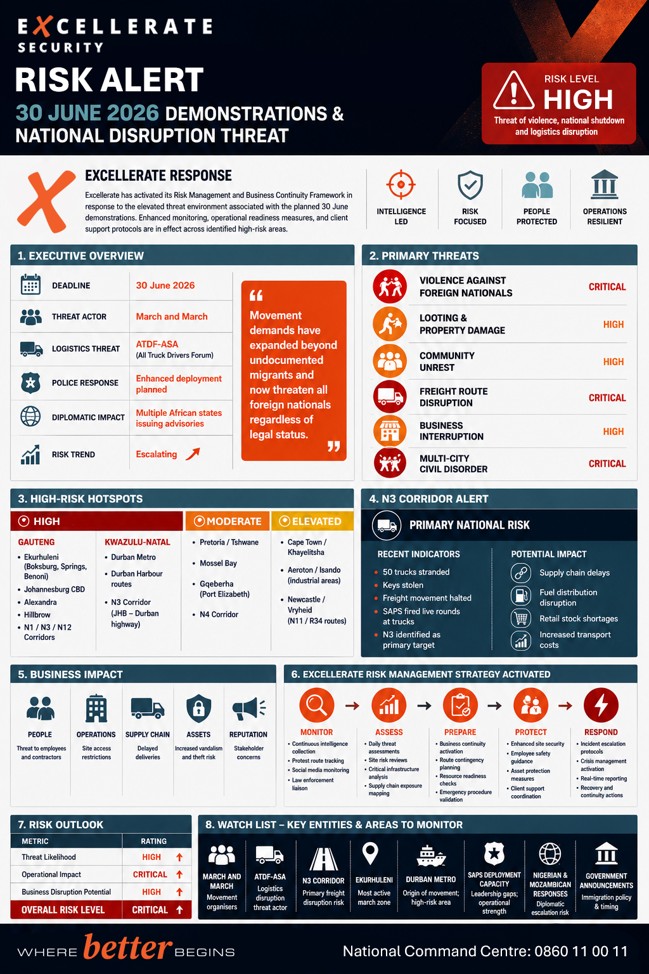
30 JUNE 2026 XENOPHOBIC / ANTI-FOREIGN NATIONAL PROTESTS SOUTH AFRICA – UPDATE
REPORT DATE: 23 JUNE 2026
EXECUTIVE SUMMARY – WHAT HAS CHANGED IN THE LAST WEEK
- SAPS publicly confirmed operational readiness on 21 June, with Acting Police Minister Cachalia and Acting National Commissioner Dimpane briefed on national and provincial plans. The government’s message: peaceful protest will be permitted, lawlessness will not.
Additionally, the Acting National Commissioner has issued a national directive confirming that only authorised law enforcement and immigration officials may request identification documents or determine an individual’s immigration status.
The directive further instructs SAPS members to take action against any individual or group attempting to unlawfully interfere with foreign nationals, businesses, schools, healthcare facilities, or public access.
- Cape Town march on 20 June drew only ~60 people — significantly below the anticipated 500. Heavy multi-agency police presence likely suppressed attendance. This is a tactical data point, not a signal of reduced threat: small Cape Town numbers are consistent with the movement’s centre of gravity remaining in Gauteng and KZN.
- AU Mid-Year Summit in Cairo on 24 June now includes Ghana’s requested agenda item on xenophobic attacks against African nationals in South Africa. South Africa is pushing back, proposing a counter-agenda on migration “push and pull factors.” The outcome of this debate will directly influence the continental retaliation trajectory.
- Nigeria’s federal government (18 June) confirmed that retaliatory measures against South Africa fall within the National Assembly’s jurisdiction – the executive is still engaging diplomatically. This places a formal legislative vote on MTN / MultiChoice / Shoprite licence sanctions as a live near-term risk.
- Herman Mashaba / ActionSA (19–22 June) publicly frames enforcement as distinct from xenophobia, lending political legitimacy to the movement’s demands and creating electoral cover for escalation. This is a meaningful narrative shift entering the final week.
- Repatriation numbers confirmed: Ghana ~1,000; Nigeria ~1,000+; Mozambique ~700; Malawi ~171; Zimbabwe ~139. Total: ~3,000+ foreign nationals have already left. The transit and repatriation sites (Durban Sherwood Park, OR Tambo, Musina) now represent concentrated, vulnerable populations.
HIGH RISK AREAS – NO MATERIAL CHANGE, CAPE TOWN DOWNGRADED SLIGHTLY
- CRITICAL: Durban/eThekwini (39 named KZN locations), Johannesburg CBD/Yeoville/Mayfair/Newtown, Ekurhuleni (Benoni, Brakpan, Springs, Germiston), Pretoria (Arcadia, Pretoria Central, Mamelodi), N3 corridor
- HIGH: Mpumalanga (9 locations including Mbombela, Middleburg), Eastern Cape (Gqeberha, Komani), Western Cape CBD/Khayelitsha (slightly downgraded from earlier assessment based on 20 June attendance), Musina/Beitbridge border zone
- ELEVATED: Free State (Bloemfontein), Northern Cape (Kimberley), Limpopo (Polokwane), North West (Rustenburg)
Further to ongoing intelligence monitoring, Excellerate representatives attended a SAPS Gauteng operational coordination meeting on 22 June 2026 to discuss preparations for the planned protest action on 30 June 2026.
SAPS confirmed that several high-risk areas have been identified across Gauteng and that operational deployment plans have been finalised. Public Order Policing (POP) members, together with local SAPS resources, have been allocated to all identified high-risk areas to ensure an appropriate law enforcement response should protest activity materialise.
To support operational mobility and maintain access to critical routes, SAPS has also arranged dedicated towing and recovery resources across all regions. These resources will be deployed to remove obstructions and assist in reopening roads should access routes be blocked during protest activity.
Importantly, SAPS advised that organised taxi associations and major labour unions are currently not expected to participate in the planned action. While this is viewed as a positive indicator and may reduce the likelihood of widespread transport disruptions and mass mobilisation, SAPS emphasised that the situation remains dynamic and subject to change based on developments closer to 30 June.
Based on the information shared during the briefing, SAPS remains confident in its operational preparedness and has implemented a coordinated provincial response framework aimed at maintaining public order, protecting critical infrastructure, and ensuring the free movement of people and goods throughout Gauteng.
CONCLUSION
The Excellerate Risk Alert of 11 June 2026 remains substantively accurate. The two most significant developments since the brief are the AU Cairo Summit on 24 June (a new escalation pathway not previously in view) and the confirmed SAPS operational readiness.
Our Civil Unrest Strategy is continuously active and updated in real time. We partner with intelligence agencies, monitor protest activity, social instability indicators, government responses, and emerging flashpoints across relevant geographies using a combination of open-source intelligence, social media signals, and verified on-the-ground reporting.
We will continue to maintain close liaison with SAPS, Public Order Policing units, intelligence partners, and local law enforcement structures and will provide updates should the threat picture change.